Ethylene oxide (EO) in the warehouse: where can EO remain and when can it be released?

In brief
Ethylene oxide (EO) can be present in several parts of a logistics load within a warehouse. It may remain in the product, packaging materials, cardboard, protective materials, wooden pallets and the air trapped between boxes or beneath wrapping film.
Any EO present may be released particularly when enclosed spaces and packaging layers are opened. Examples include opening trailers, containers and outer cartons or removing stretch film.
The STERILE EO symbol helps identify medical devices that have been sterilised using ethylene oxide. However, the symbol does not indicate how much EO may still be present or how much may be released during logistics activities.
A pallet may contain more EO than is visible from the outside
A pallet containing sterile medical devices usually looks no different from any other pallet in a warehouse. However, ethylene oxide may still be present in the product, the packaging and the air between the boxes.
In simplified terms, EO can occur in a load in two ways:
- Materials can absorb ethylene oxide during sterilisation and gradually release it afterwards.
- Released EO may remain present or temporarily accumulate in enclosed spaces, such as between boxes or beneath stretch film.
Ethylene oxide is therefore not always located in one clearly identifiable place. To properly assess potential exposure moments, it is important to consider the entire logistics load as well as the activities performed around it.
Where can ethylene oxide remain within a load?
The product and primary packaging
Materials such as plastics, rubber, textiles and foam can absorb EtO during the sterilisation process. Following sterilisation, these materials may gradually release the gas again.
Ethylene oxide may remain present for longer in products containing cavities or narrow channels because air exchange takes place more slowly in these areas. Primary packaging materials may also retain residual EO or affect the rate at which the gas is released.
Protective materials, paper and cardboard
The product itself is not the only potential source. Materials surrounding the product may also absorb ethylene oxide or influence the rate at which it is released. Examples include:
- foam;
- information leaflets;
- cardboard dividers;
- product boxes;
- outer cartons.
The amount of EO that remains present and the rate at which it is released may depend on factors including the type and quantity of material, the number of packaging layers and how densely the goods are stacked. Conditions during sterilisation and aeration may also play a role.
Wooden and plastic pallets
Wood is porous and has an open cellular structure. This allows ethylene oxide to penetrate more deeply into the material and be absorbed by the pallet. The gas can subsequently be released gradually, which means that a wooden pallet may continue to off-gas over a longer period.
Plastic pallets are generally less porous. However, this does not automatically mean that a plastic pallet cannot contain or retain EO.
Wrapping film and enclosed spaces
Stretch film, pallet covers and other enclosed packaging layers can restrict air exchange around the products. EO released from products, boxes or packaging materials may therefore remain trapped for longer between packaging layers or beneath the film.
The same situation can occur in other enclosed logistics spaces, such as trailers, containers and unit load devices (ULDs). When these spaces are opened, the air exchange changes. Any ethylene oxide present may consequently be released into the immediate working environment.
How can you identify an EO-sterilised product?
Medical devices sterilised using ethylene oxide can be identified by the STERILE EO symbol. This symbol is included in ISO 15223-1.

The symbol may be displayed on:
- the sterile product packaging;
- the product label;
- the product box;
- the instructions for use.
However, the symbol is not always displayed on the outer transport carton or pallet label. The absence of a visible symbol on an outer carton therefore does not automatically mean that the contents have not been sterilised using ethylene oxide.
Furthermore, the symbol only provides information about the sterilisation method used. It does not indicate the amount of EO still present in the product or load. Nor does it show how much EO may be released during logistics activities.
During which logistics activities can EO be released?
During activities in which enclosed spaces or packaging layers are opened, the air exchange can change suddenly. EO present between boxes, beneath wrapping film or within packaging materials may consequently enter the breathing zone of employees.
The following activities therefore warrant particular attention:
- opening a trailer, container or ULD;
- removing a pallet cover or stretch film;
- removing boxes from a pallet;
- opening outer cartons and internal packaging;
- repacking;
- relabelling;
- kitting;
- carrying out quality inspections.
During these activities, the load is opened or taken apart. Air that was previously trapped between packaging layers or within enclosed spaces can then spread into the working environment.
Does opening every box automatically result in exposure?
Not every opened box automatically presents a significant risk. Whether employees are exposed to a relevant amount of EO depends on several circumstances, including:
- the quantity of goods;
- the amount of residual ethylene oxide;
- the time elapsed since sterilisation;
- ventilation within the area;
- the temperature;
- the duration of the activities;
- how the activities are performed.
The presence of EO-sterilised products alone is therefore not sufficient to determine actual exposure. The complete flow of goods and all activities performed around the load must also be considered
Look beyond the product itself
In a logistics environment, ethylene oxide is not necessarily present in one fixed location. It may be found in:
- the product;
- the primary packaging;
- protective materials;
- paper and cardboard;
- the pallet;
- the air between packaging layers.
The STERILE EO symbol can help identify medical devices sterilised using ethylene oxide. However, it does not provide information about the current amount of EO present or potential exposure during logistics activities.
It is therefore important to look beyond the individual product. Assess the entire logistics load and pay particular attention to activities involving the opening of trailers, containers, pallets, boxes or other packaging layers.
Assess exposure to EO
The STERILE EO symbol confirms that a product has been sterilised using ethylene oxide, but it does not provide insight into the amount of EO released during storage or logistics activities.
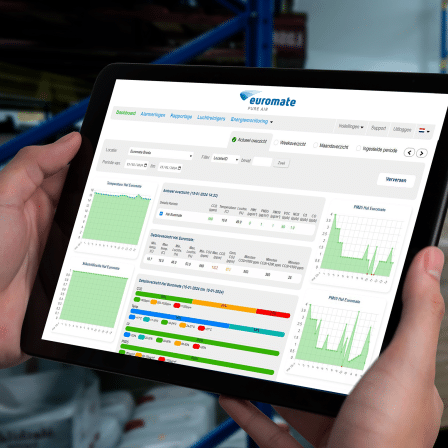
EO monitoring can identify where and during which activities ethylene oxide is present in the working environment. The monitoring results provide a concrete basis for determining appropriate next steps.
Gain insight into actual EO exposure within your warehouse.